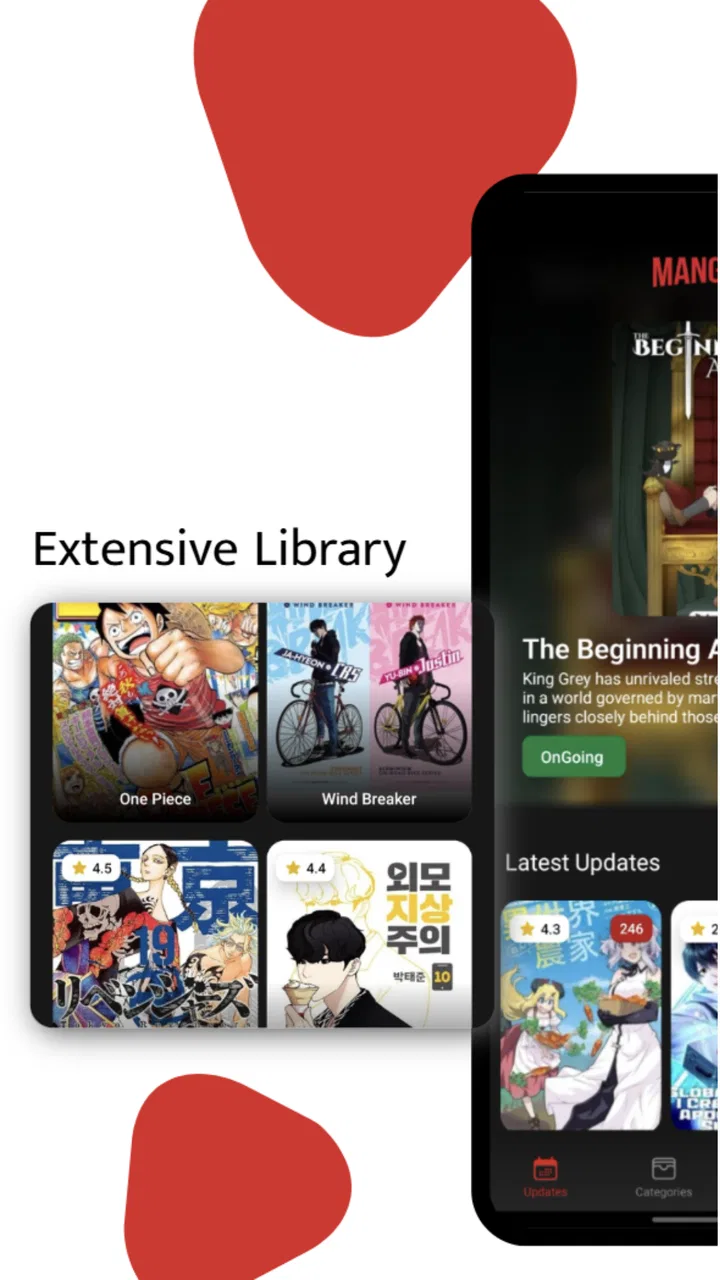
MangaRise - Manga Reader
- 3.9
- Rating
- 50.00K
- Installs
- Free
- Price

 Analysis by App-foxy
I approached MangaRise as a practical reading app rather than judging it by its short store label. It belongs to the comics category and is presented as a manga and manhwa companion, so its main appeal is straightforward: keeping illustrated stories within easy reach on an Android phone. After spending time with it, I see a free reader aimed at people who want a simple place to explore this kind of content without treating the app like a full social platform or a highly customized reading system.
That distinction matters. A manga reader can be useful because it reduces the distance between wanting to read and actually opening a chapter, but the experience also depends on how clearly the app communicates its choices. I paid attention not only to reading comfort, but also to what the app makes visible about control, account-related decisions, and data-sensitive moments. My overall impression is cautiously positive: MangaRise is easy to understand at a glance, but I would still use it with the same care I apply to any free content app.
What the reading experience is really suited to
The strongest use case is casual reading on a phone. If I have a short break, want to continue a comic while travelling, or simply prefer carrying stories digitally instead of handling printed volumes, an app in this category makes sense. MangaRise keeps its identity focused on manga and manhwa, which is more useful than a general comic app when those are specifically the formats I want to browse.
You May Also Like

 Blood Strike: 2.5 Anniversary
Blood Strike’s Loadouts Turn Every Drop Into a Tactical Gamble
A close look at Blood Strike’s custom loadouts: how fast access to signature weapons reshapes its battle royale rhythm, rewards preparation, and narrows the gap between fights.

 Pandora - Music & Podcasts
Pandora’s Music Is Easy to Start, but Harder to Recover
Pandora’s strength is its low-effort path from a seed to a station. Its weak spot is how much confidence it asks you to place in connection, setup, and quiet recovery.

 8 Ball Pool
 Is Built on Rivalries, Rematches, and Routine
A close look at the rivalries, rematches, shared routines, and unanswered safety questions that turn a quick pool match into a persistent mobile community.

 Samsung Music
’s Quiet Strength Is Playing What You Already Own
Its reach comes less from spectacle than from dependable access to a personal library. That simplicity is both the app’s strongest retention engine and its ceiling.

 AccuWeather: Weather Radar
AccuWeather Review: A Quick, Clear Forecast for Everyday Decisions
For everyday plans, the best forecast is the one you can understand quickly. AccuWeather makes rain timing, radar, and local conditions easy to act on, with a few trade-offs.

 Hill Climb Racing
Why Hill Climb Racing Still Turns Crashes Into One More Run
A tiny car, a bumpy hill and one more upgrade: Hill Climb Racing keeps resurfacing because its simple chaos makes every near-miss feel personal.
More From Our News Desk



I would not choose it automatically for every type of reader. Someone who already has a carefully organized digital library, expects advanced synchronization between several devices, or wants a reader built around extensive personal customization may prefer a more established alternative. MangaRise feels better suited to the person who wants a direct starting point and does not want to spend much time configuring a reading environment before opening a story.
The app is free, which lowers the barrier to trying it. That is helpful for a reader who is still deciding whether a mobile manga companion fits their habits. At the same time, free access is not a reason to switch off judgment. I recommend looking at the permission prompts and any privacy choices during setup instead of accepting every screen automatically. The practical value of a reader should be weighed alongside the amount of control it gives you.
Its developer is listed as Dhaouadi, and the app has built a modest public audience: it shows an average rating of 3.9 from around 1.5 thousand ratings, with more than 190 written reviews. Those figures suggest that people are using it, while also showing that the experience is not universally perfect. I read that combination as a reason to try it personally rather than treating the rating as a final verdict.
A useful companion for short, repeated reading sessions
My preferred way to use an app like this is in small sessions. I might open it during a lunch break, read a few pages, stop before the next appointment, and return later. That pattern is different from sitting down for a long evening of reading, where details such as navigation speed, page handling, and continuity become much more important.
For a commuter, the benefit is convenience rather than spectacle. A phone is already available, and a dedicated comics app keeps the activity separate from a browser full of unrelated tabs. For a new reader, the category focus can also make discovery feel less intimidating than searching through a broad entertainment service.
There is a trade-off, though. A phone screen is not the same as a printed page or a larger tablet display. Small lettering, detailed panels, and vertical manhwa layouts can demand more attention, especially when brightness is low. I found it sensible to test a few different reading positions before settling into a long session. If your eyes tire quickly from mobile reading, MangaRise will not solve that basic screen limitation.
How it compares with familiar alternatives
The usual alternatives fall into three groups: a mobile browser, a general comic platform, or a dedicated library app connected to content you already own. A browser can be more flexible, but it is also easier to lose your place among tabs and harder to keep the reading experience feeling separate from ordinary web use. A broad comic service may offer a wider mixture of formats, while a focused manga and manhwa app can feel more relevant when those are the only stories I want.
A library-oriented reader is often the better choice for someone who already owns or manages a large collection. Such readers usually make organization the center of the experience. MangaRise is more appealing when discovery and immediate reading matter more than maintaining a complex personal archive.
I would also avoid comparing it with premium services purely on the basis of price. A paid or subscription-based alternative may provide a more polished ecosystem, clearer content management, or stronger cross-device continuity. MangaRise’s free entry is attractive, but the right comparison is not “free versus expensive”; it is “simple access versus a more controlled and established reading workflow.”
Trust, controls, and the choices I would make
I’d use this section to focus on the small decisions that make a reading app feel comfortable over time: what I allow at setup, what I leave off, and which controls I revisit after a few sessions. A useful habit is to change one choice at a time, then read normally for a day or two; that makes it easier to tell whether a setting genuinely helps or merely adds friction.
Why the app deserves a careful first look
MangaRise was released on January 26, 2024, and its current version is 1.4.2. It supports Android 7.0 and later, so it can reach readers using older compatible phones as well as newer devices. That broad compatibility is convenient, particularly if I am trying to give an older handset a useful reading role rather than replacing it immediately.
Still, compatibility should not be confused with a guarantee of identical behavior on every phone. Older Android devices can handle screen scaling, storage, and background activity differently from newer models. My advice is to begin with a short session, check how comfortable the display is, and pay attention to whether the app asks for access that feels unrelated to reading.
The content rating is Everyone, which makes the app appear suitable for a broad audience. I would treat that as a helpful age-labeling signal, not as a substitute for checking the individual stories available through the service. Readers, parents, and younger users should still use their own judgment about the themes and presentation of particular comics.
Verified controls matter more than reassuring language
When I evaluate a free app, I look for visible choices rather than relying on a friendly description. The important moments are usually the first launch, any sign-in or account screen, permission requests, notification prompts, and settings related to saved activity. I want to know what I am agreeing to before I continue, and I prefer controls that are written plainly enough to understand without guessing.
With MangaRise, I would keep the setup deliberately conservative. If a permission is optional, I would decline it initially and see whether the core reading experience still works. This is a useful test because it separates what the app needs for its main purpose from what may simply improve convenience or personalization.
I also recommend checking the device’s Android permission manager after installation. That gives me a second place to review access, rather than depending only on the wording shown during setup. If I later stop using the app, I would revoke permissions I no longer want active and uninstall it instead of leaving an unused reader on the phone indefinitely.
The best trust signal is not a promise; it is a clear choice I can understand and change. That principle is especially important for a free app, where the reader should not feel pressured to exchange more access than necessary just to browse comics.
Data-sensitive moments deserve attention
Reading history can be more personal than it first appears. The titles I open, the chapters I finish, and the subjects I search for can reveal preferences that I may not want broadly associated with me. I therefore avoid assuming that a reading app handles this information in a particular way unless the app or its privacy materials explain it clearly.
My practical habit is to avoid entering unnecessary personal details. If an account is offered, I would consider whether it provides a benefit I genuinely need, such as preserving progress, before creating one. I would not use a primary password that I rely on elsewhere, and I would review whether the app gives me a straightforward way to sign out or remove account information.
Notifications are another small but real privacy issue. A message appearing on a lock screen can reveal what I am reading to someone nearby. I would keep notifications off unless they provide a clear advantage, and I would use Android’s notification settings to limit lock-screen details when needed. This is particularly sensible on a shared device or in a workplace.
Network use also deserves common-sense attention. I would read over a trusted connection, avoid entering sensitive information on an unfamiliar network, and watch for unexpected prompts. None of these steps is complicated, but they help keep the app’s role narrow: a reading tool, not a place where I casually disclose information.
Keeping control during everyday use
A realistic routine might look like this: I install MangaRise on an older spare phone, open it during a train ride, and decide whether I want to continue using it after the first session. Before settling in, I check the app’s permissions, turn off notifications that are not useful, and avoid creating an account until I know whether the reader fits my habits. After reading, I close the app and review its recent activity if anything seemed unexpected.
That workflow gives me useful information quickly. I learn whether the screen is comfortable, whether navigation feels natural, whether the app interrupts me, and whether any control is difficult to find. It also prevents a common mistake: committing personal information to an app before discovering that the basic reading experience is not a good match.
If I share the phone with family members, I would be even more deliberate. I would check whether the app opens to the last viewed material, keep the device protected with its normal lock screen, and avoid leaving a reading session visible. These are simple habits, but they matter because convenience can otherwise expose more of my activity than I intended.
Where the friction may appear
The public rating indicates that MangaRise has room to improve, and I would not expect every part of the experience to feel as mature as a long-established reading ecosystem. A reader can be perfectly usable while still having rough edges in discovery, organization, responsiveness, or account handling. Those details become more noticeable after the novelty of trying a new app wears off.
My biggest caution is about expectations. The app’s identity is clear, but a short summary does not tell me how well it will serve a large personal library, how smoothly it will preserve progress across devices, or how much control it offers over the reading environment. I would test those areas directly instead of assuming that a manga-focused label means every advanced feature is present.
Another limitation is the dependence on the phone itself. Even a well-designed reader cannot make a small display ideal for every panel. If I regularly read visually dense pages, a tablet or a dedicated larger-screen alternative may be more comfortable. MangaRise is therefore a practical option for portability, not automatically the best option for long, high-detail sessions.
Who should try it, and who should skip it
I would recommend trying MangaRise if you want a free Android app focused on manga and manhwa, read mainly in short sessions, and prefer a direct mobile experience over browsing through a general website. It is also worth considering if you are using an older compatible phone and want a lightweight entertainment purpose for it.
I would be more cautious if your priority is a carefully managed collection, extensive account controls, or a reading setup shared across several devices. In that situation, compare it with a library-focused reader or a more established comic service before moving your whole routine. MangaRise can be part of your reading setup without needing to become the only place you read.
I would also skip it if you dislike reviewing permissions, notifications, and account choices. That is not a criticism unique to this app; it is simply the wrong kind of product for someone who wants every decision handled automatically. A free reader is most comfortable when I remain willing to spend a minute checking what it asks for.
My measured recommendation
MangaRise has a sensible purpose and a low-cost way to test it: it is free, aimed at comics, and available for Android devices running version 7.0 or newer. The developer, Dhaouadi, has released a current version of 1.4.2, and the app has passed the early stage of being used by only a handful of people, with over 50 thousand installs. That gives me enough reason to take it seriously, while the 3.9 average reminds me to keep expectations realistic.
My recommendation is to install it as a trial companion, not as an unquestioned replacement for every other reading option. Start with a short session, examine the visible controls, keep optional permissions and notifications limited, and decide whether its navigation and organization suit the way you actually read. If the app makes those basics comfortable, it can be a convenient addition to a manga routine.
In the end, I like MangaRise most for its straightforward role and free entry, but I would choose a different service for a deeply organized library or a more demanding multi-device setup. For readers who value portability and want to explore manga or manhwa without a large commitment, it is worth a careful try. The right approach is simple: enjoy the reading, keep your choices visible, and let the app earn a larger place in your routine over time.
FAQs for MangaRise - Manga Reader
01What features does MangaRise offer to enhance the reading experience?
MangaRise provides a seamless reading experience with features like customizable reading modes, including vertical and horizontal scrolls. Users can adjust brightness and zoom levels to suit personal preferences. The app also offers a bookmark feature to save progress, along with a comprehensive library management system to organize your favorite manga efficiently.
02Is MangaRise free to use, or does it include in-app purchases?
MangaRise is available as a free download, offering access to a wide range of manga titles. However, it includes in-app purchases and an optional premium subscription. The premium version removes ads, provides early access to new chapters, and offers additional customization options for a more personalized experience.
03How extensive is the manga library on MangaRise?
MangaRise boasts an extensive library, featuring thousands of manga titles across various genres such as action, romance, fantasy, and more. The app frequently updates its collection, ensuring users have access to the latest chapters and new releases. It caters to both popular series and niche titles, appealing to a diverse audience.
04Can I download manga to read offline on MangaRise?
Yes, MangaRise allows users to download manga chapters for offline reading. This feature is particularly useful for users who wish to enjoy their favorite manga without an internet connection. Downloaded chapters are stored within the app, ensuring easy access even when traveling or in areas with limited connectivity.
05Is MangaRise compatible with both Android and iOS devices?
MangaRise is designed to be compatible with both Android and iOS platforms. The app provides a consistent and optimized experience across different devices, ensuring smooth navigation and functionality. Regular updates are released to enhance compatibility and introduce new features, catering to the needs of all users.
Pros
- User-friendly interface and easy navigation.
- Extensive library with diverse manga genres.
- Offline reading mode available.
- Regular updates with new releases.
- High-quality images and text.
Cons
- Ads can interrupt the reading experience.
- Limited customization for reading settings.
- Requires internet for initial download.
- Occasional loading delays on older devices.
- In-app purchases for premium features.

MangaRise - Manga Reader
Gallery